Question
- “VAX/VMS, then, is a collection of procedures that exist in the address space of each process.” Explain in your own words what this statement means.
- In VAX/VMS, procedures are isolated per process
Introduction
- Outlines memory management policies and decisions made in the design and implementation of the first release of VAX/VMS OS
VAX-11 HW
- Process = basic entity
- 32-bit virtual addr space
- 512-byte pages
- 32-bit virtual address, 21-bit virtual page number, 9-bit byte offset within the page
- VM
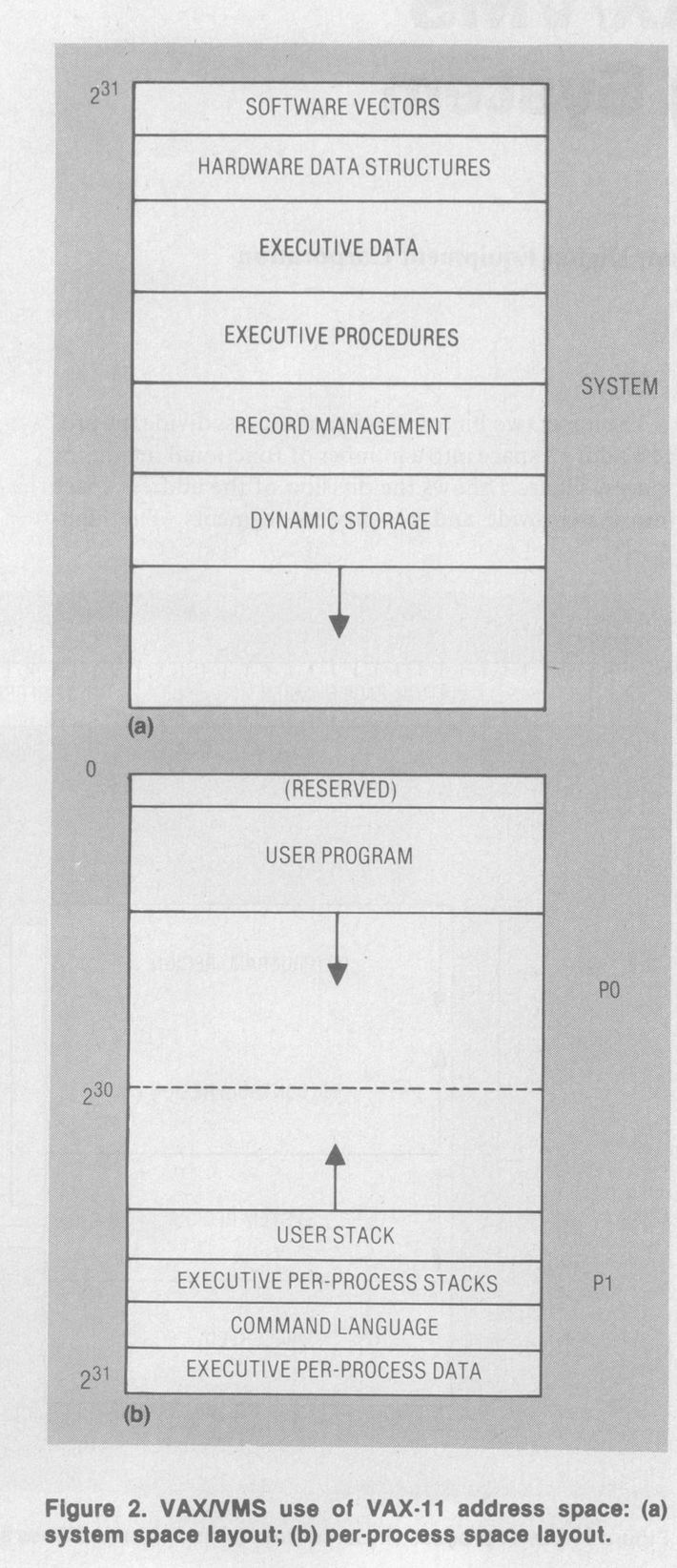
- upper two bits of vaddr divide the process address space into functional regions or spaces
- High-address half of the address space (Bit 31 = 1) is system space and it’s shared by all processes in the system
- Low-address half of address space (bit 31 = 0) is process space and unique to each process
- Paging
- Each region in memory is defined by a page table
- fields:
- valid bit, Page Table Entry or PTE<31>
- checks whether it’s loaded into main memory
- protection field, PTE<30:27>
- indicates privilege required to read or write
- modify bit, PTE<26
- field used by os, PTE<25:21>
- physical page frame number, PTE<20:0>
- valid bit, Page Table Entry or PTE<31>
- fields:
- System space has a separate page table called the system page table
- Translation of a process-space virtual address involves two accesses:
- one to the system page table, to calculate the physical address of the process page table
- one to the process page table, to calculate the physical address of the specified element
- Each region in memory is defined by a page table
Use of address space by VAX/VMS
System region:
- executive code and data
- process-specific data structures
- process page tables
- Vector region
- contains pointers to executive service routines in system space With the vector region, it shares the OS with all other processes in the system.
…
Memory-management implementation
Issues in paging systems:
- effect of one or more heavily paging programs on other programs in the system
- high cost of program startup and restart time in virtual memory environments
- increased disk workload
- processor time consumed by searching page lists in OS
To fix above issues, VAX/VMS memory management system is divided into two basic components: the pager and the swapper
- the pager - OS procedure that executes when a page fault occurs
- responsible for loading and removing process pages into and out of memory
- in paper used LRU eviction
- responsible for loading and removing process pages into and out of memory
- the swapper - separate process responsible for loading and removing entire processes into and out of memory
Process-local page replacement policy
- when a page must be removed from memory, the page to be removed is selected from the process requesting a new page.
- limit is placed on the amount of physical memory a process may occupy
Resident list set - set of pages currently in memory for a process resident-set limit - maximum size of the resident set
When a page is removed from a process’s resident set, it is placed on one of two page lists:
- free page list - if modified bit = 0
- modified page list - if modified bit =1, must be written to the paging file (modified page list) If a process faults a page that is on either of the above list, page is returned to process’s resident set
Clustering
Clustering of pages - VAX/VMS page sizes is small so to reduce I/O ops, it reads and writes several pages at a time known as clustering
- When the pager locates a page to be read from exec file, it determines the cluster size
- default cluster size specified by user
Modified page list
thinking it’s like swap space in unix… Purpose:
- acts as a cache for recently removed resident-set pages that have been written to
- allows for clustering writes to page file
- like a daemon to handle writes of pages to disk
Has a low limit and high limit of list size
- 20 or 30 for low
- 100 + for high
VAX/VMS delays modified-page write requests with this queue. Due to that it provides 4 optimizations:
- Modified page list acts as a cache of recently removed pages
- When a write request must be performed, many pages can be written at once
- Pages can be arranged on the paging file so that clustering on read requests is possible
- Because writes are delayed many page writes are entirely avoided because either the pages are faulted again or the program terminates
Demand-zero page - is a page that is created for a program and initialized to zero on demand
- pages that were initially zero like uninitialized arrays, are not stored by the linker in the execution file. Linker creates a null-sized segment of demand-zero pages
- when the page faults (on demand zero page), the pager allocates a physical memory page and fills it with zeros and then add the page to resident set of the process
copy-on-reference - pager sets the modify bit of the PTE for a writable page when it’s first loaded from the executable file
paging in system space
- has system resident set
- for it’s process page tables, a page table is not removed unless it’s empty
The Swapper
swaps between memory and the backing store. also responsible for writing the modified page list Objectives:
- keep the highest priority processes resident
- avoid the typically high paging rates generated by resuming a process in most paged systems
When a process is removed from memory, its entire resident set is written to the swap file, along with some process-specific OS database
what does it do
- lets say a process not in memory becomes able to execute
- the swapper allocates pages for the resident set, page tables and OS data structures
- then the swapper updates the process’s page table entries to reflect new virtual-to-physical mappings
- Process creation
- when a new process is created, the swapper swaps in a process shell, which provides the initial environment in which a program can be executed
Program control of memory
VAX/VMS provides routines for processes to:
- expand or contract it’s P0 or P1 region
- P0 heap, P1 stack
- increase or decrease resident set size
- lock or unlock pages in resident set (to keep pages in set)
- lock or unlock the process in memory (process can’t be swapped)
- create and or map global or private section into the process addr space
- produce a record of the page-fault activity of the process