source: https://dl.acm.org/doi/abs/10.1145/3341301.3359657
Abstract
Snap - microkernel-inspired approach to host networking called Snap.
- Userspace networking system
- Snap enables fast development and deployment of new networking features
Goal
- Performance - high performance networking system in userspace
- Dev experience - able to develop networking system without needing kernel devs or bundling with app devs
Background
- Intuition:
- needs with kernel-based networking was hampered by lengthy dev and release cycles
- Move networking functionality out of the kernel and into userspace modules through a common framework → Snap
- Snap Components
- Dataplane interaction occurs over custom interfaces that communicate via lock-free shared memory queues
- Pony Express - new communication stack that implements a custom reliable transport and communications API
- Architecture:
- Composition of recent ideas in userspace networking, in-service upgrades, centralized resource accounting, programmable packet processing, kernel-bypass RDMA functionality, and optimized co-design of transport, congestion control and routing
- High rate of feature development with microkernel-inspired approach of developing in userspace with transparent software upgrades
- **custom kernel packet injection driver and custom CPU scheduler that enable interoperability without requiring adoption of new application runtimes
- Interoperability between kernel function and application thread schedulers
- Encapsulates packet processing functions into composable units called “engines”, which enables modular CPU scheduling, and incremental and minimally disruptive state transfer during upgrades
- Minimizes I/O by tuning Snap and Pony Express transport
- 3x better transport processing efficiency than baseline Linux kernel
- Composition of recent ideas in userspace networking, in-service upgrades, centralized resource accounting, programmable packet processing, kernel-bypass RDMA functionality, and optimized co-design of transport, congestion control and routing
Snap as a Microkernel Service
Snap implements host networking functionality as an ordinary Linux userspace process.
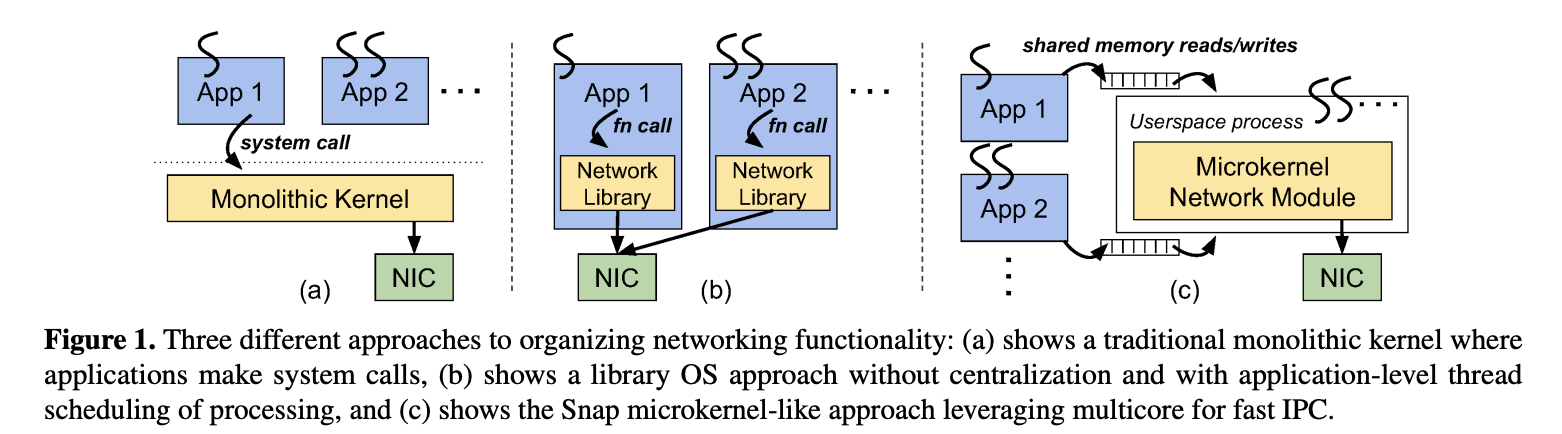 Note: Snap differs from library OS approach to networking with shared memory queues to communicate interprocess and separating network from app in user-level
Benefits:
- Decouples release of networking functionality from both kernel and application binary release cycles
- Decouples application threading and CPU provisioning from network services. This enables managing networking latency and spin-polling capability as a system-level resource
- Scale network module independently of application
Snap Architecture Overview
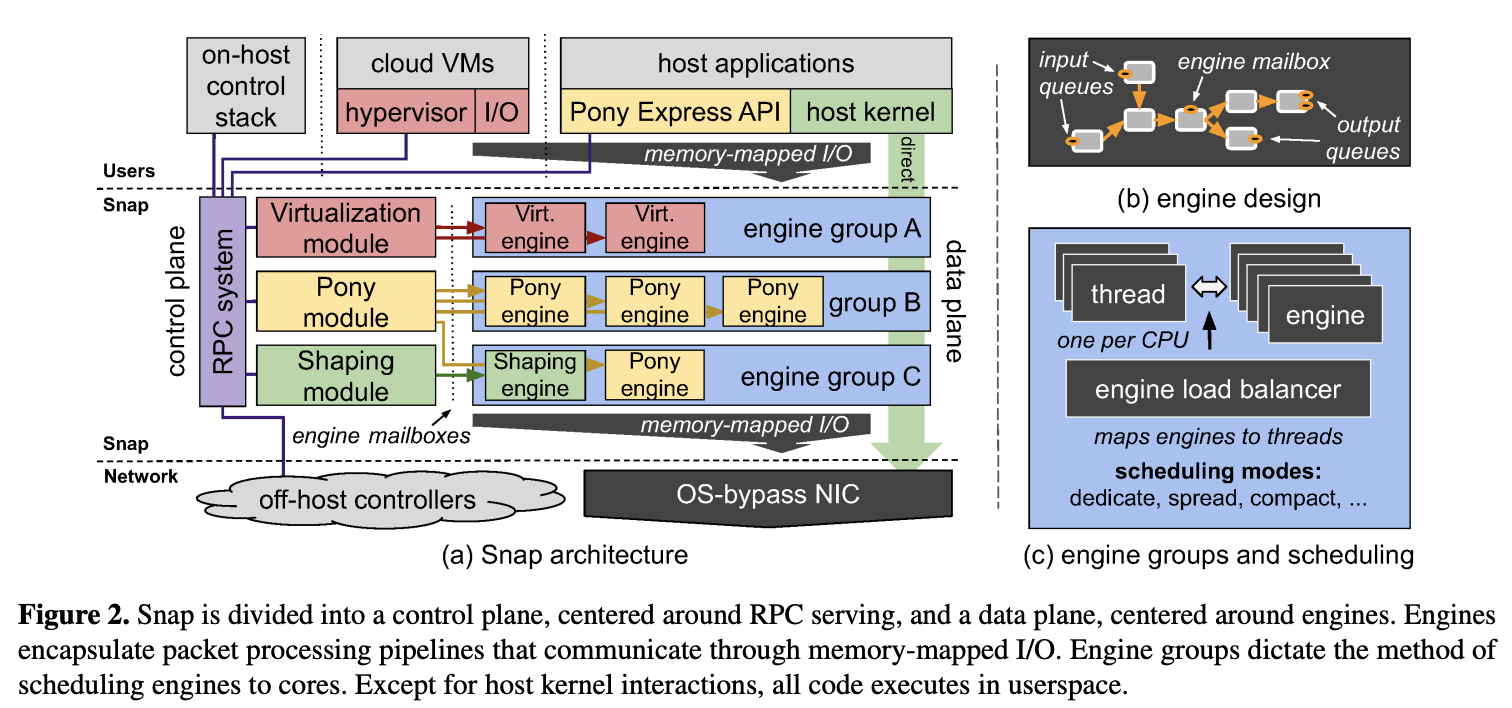
- Engines - unit of encapsulation for data plane operations
- ex:
- packet processing for network virtualization
- pacing and rate limiting for bandwidth enforcement
- stateful network transport
- ex:
- Control plane and data plane interact through specialized uni-directional RPC called engine mailbox
Engine Design
Engines are stateful, single-threaded tasks that are scheduled and run by a Snap engine scheduling runtime
- never blocks, never waits, never mutexes
Modules and Control-to-Engine Communication
Snap modules are responsible for setting up control plane RPC services, instantiating engines, loading them into engine groups, and proxying al user setup interactions for those engines.
- Control components synchronize with engines lock-free through an engine mailbox
- Mailbox is a queue of depth 1 on which control components post short sections for work for synchronous execution by an engine, on the thread of the engine, and in a manner that is non-blocking with respect to the engine.
Engine Groups and CPU scheduling
Bundles engines into groups with a specific scheduling mode which dictates a scheduling algorithm and CPU resource constraints. Called engine groups
Modes:
- Dedicating cores
- Engines are pinned to dedicated hyperthreads on which no other work can run
- Spreading engines
- Scales CPU consumption in proportion to load, with focus on minimizing scheduling tail latency
- Compacting engines
- Collapses work onto as few cores as possible, combining the scaling advantages of interrupt-driven execution with the cache-efficiency advantages of dedicating cores
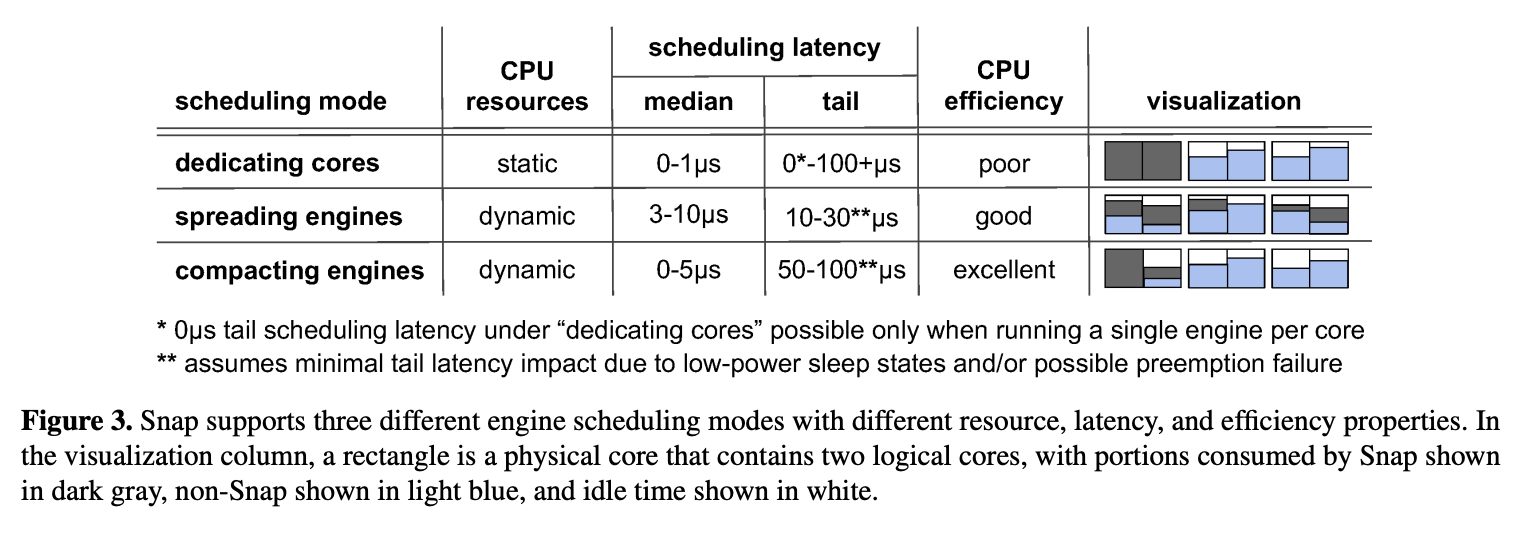
- Collapses work onto as few cores as possible, combining the scaling advantages of interrupt-driven execution with the cache-efficiency advantages of dedicating cores
MicroQuanta Kernel Scheduling Class
Snap uses MicroQuanta, new lightweight kernel scheduling class, to dynamically scale CPU resources
- MicroQuanta provides a flexible way to share cores between latency-sensitive Snap engine tasks and other tasks
- Makes sure Snap wake threads immediately
- Each Snap engine gets a guaranteed budgeted variable time slice
- Weighted fair queueing
- Used to allow Snap engines to run with real-time-like latency without starving the rest of the system
Pony Express: A Snap Transport
Reliable transport and communications stack
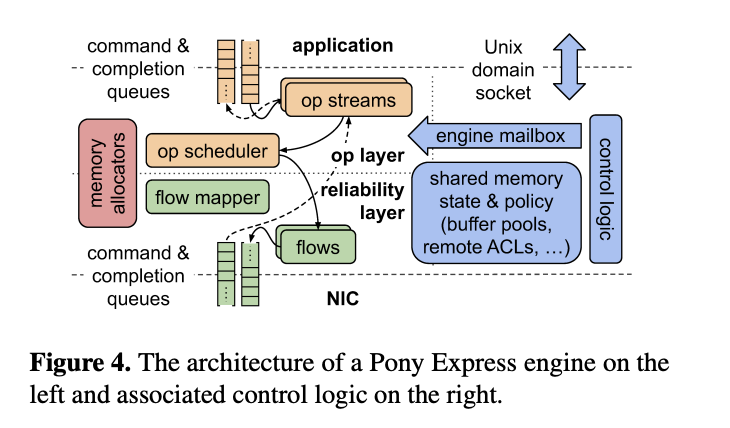
- When an application wishes to invoke an operation, it writes a command into the command queue. Application threads can then either spin-poll the completion queue, or can request to receive a thread notification when a completion is written.
- Non blocking to application
Transparent Upgrades
Snap Upgrades
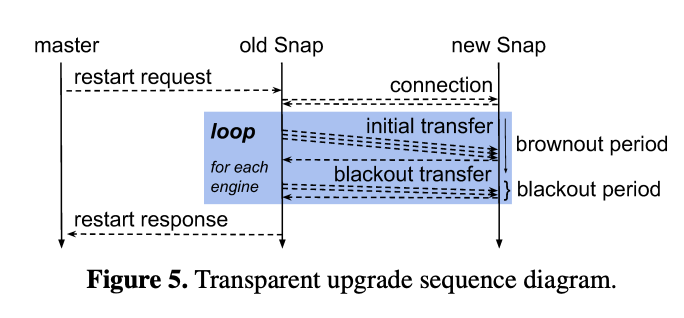
- Ability to release new versions of Snap without disrupting running applications
- Afford developers maximum flexibility in making substantial changes between releases
- Upgrade is two-phased to minimize blackout period (network stack is unavaliable)
- Initial brownout phase performs a preparatory background transfer that has minimal perf impact
- Running version of Snap serializes all state to an intermediate format stored in memory and shared with new version
- Target blackout period - 200ms or less!
- Steps:
- Snap “master” daemon launches second instance of Snap
- Old Snap connects to new Snap
- Old Snap cuts out control plane Unix socket connections and transfer them in the background along with shared emmory file descriptor handles
- New Snap reestablishes shared memory mappings and initiates structures
- Once that’s done, old engines begins blackout period by ceasing packet processing, detaching NIC receive filters and serializing state.
- New engines attach to NIC filters and deserialize states
- Once all engines are transferred this way, old Snap is terminated