Question
Q: Why does Mach support copy-on-write, and how does it implement it? A: To provide consistency, through shadow pages which is the subset of the file of the affected pages that contain changes
Abstract
- Design and implementation of virtual memory management within the CMU Mach Operating System
- Mach virtual memory consists of a single code module and its related header file
- separates software memory management from hardware support without sacrificing system performance
Mach
Goals:
- explore the relationship between hardware and software memory architectures
- design a memory management system that would readily portable to multiprocessor computing engines as well as traditional uniprocessors Supports:
- large, sparse virtual address spaces,
- copy-on-write virtual copy operations,
- copy-on-write and read-write memory sharing between tasks
- memory mapped files
- user-provided backing store objects and pagers
Design
5 basic abstractions:
- task - execution environment which threads may run
- basically a process in UNIX with a single thread of control
- thread - basic unit of CPU utilization.
- All threads within a task share access to all task resources
- port - communication channel — logically a queue for message protected by the kernel
- send and receive are primitives operations on ports
- message - typed collection of data objects used in communication between threads
- memory object - collection of data provided and managed by a server which can be mapped into the address space of a task
Operations on objects other than messages are performed by sending messages to ports
- pure MPI
- Mach permits system services and resources (kernel) to be managed by user-state tasks
- the Mach kernel itself can be considered a task with multiple threads of control
- kernel acts as a server
- which implements tasks, threads and memory object
- act of creating a task, a thread or a memory object, returns access rights to a port which represents the new object and can be used to manipulate it
The indirection of MPI allows objects to be placed anywhere on the network.
- without something like hierarchy
- for example a thread can suspend another thread by sending a suspend message to that thread’s thread port even if the requesting thread is on another node in the network
Key to efficiency:
- Virtual memory management can be integrated with message-oriented communication facility
- allows for large amounts of data including whole files and whole addr spaces to be sent in a single message with the efficiency of simple memory remapping
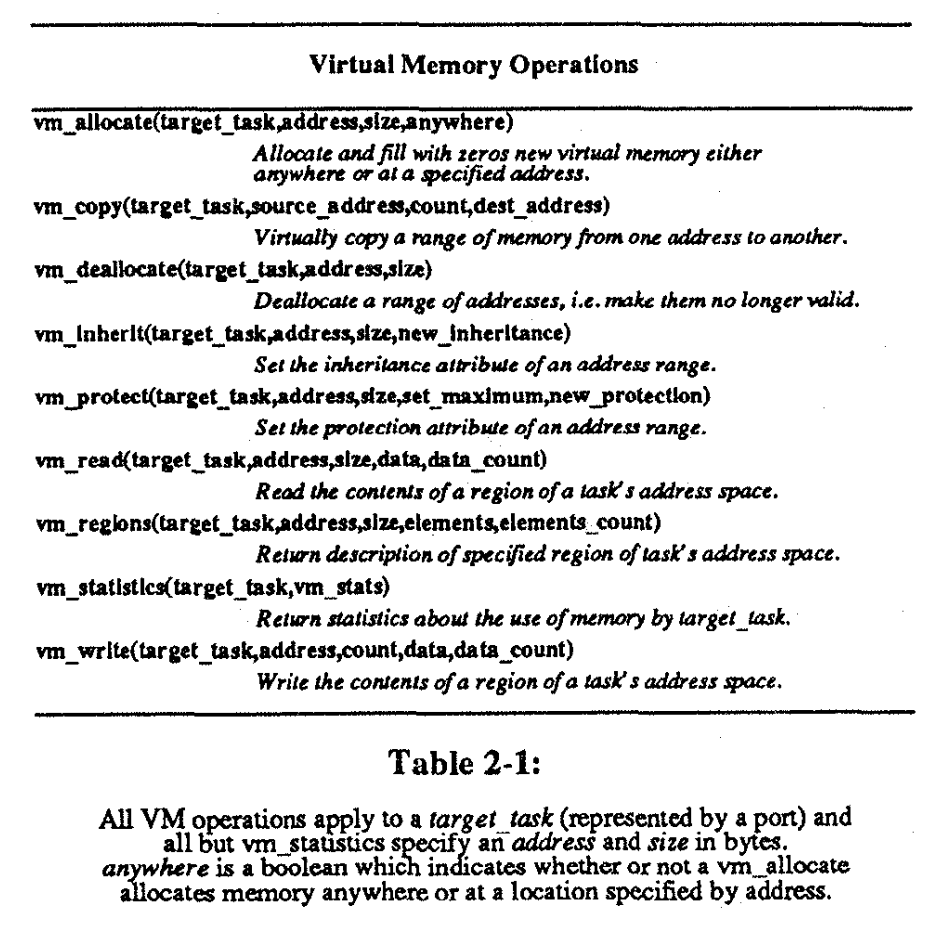
Basic Virtual Memory Operations
- allocate region of VM on a page boundary
- deallocate a region of VM
- set the protections status of a region of VM
- specify the inheritance of region of VM
- create and mange a memory object that can then be mapped into addr space of another task
Mach can have copy-on-write and read/write sharing
Implementation of Mach Virtual Memory
Four basic memory management data structures:
- resident page table
- table used to keep track of information about machine independent pages
- address map
- doubly linked list of map entries, each of which describes a mapping from a range of addresses to a region of memory object
- memory object
- a unit of backing storage managed by the kernel or a user task
- the physical map (pmap)
- a machine dependent memory mapping data structure (hw defined physical address map) implementation is split between machine independent and machine dependent sections
- Machine Dependent code implements only those operations necessary to create, update and manage the hardware required mapping data structures
- Machine independent code maintains all important virtual memory information
Managing Resident Memory
Memory per task/process
Physical memory in Mach is treated primarily as a cache for the contents of virtual memory objects
- information about physical pages is maintained in page entries in a table indexed by physical page number
- each page entry may be simultaneously linked into several lists:
- memory object list
- speed up object deallocation and virtual copy operations
- memory allocation queue
- free, reclaimable, and allocated pages used by Mach paging daemon
- object/offset hash bucket
- fast lookup
- size of Mach page is a boot time system parameter so can be configurable
- memory object list
Address Maps
address map - map of addresses within a task space to byte offsets in memory objects
- doubly linked list of address map entries where each entry maps a contiguous range of virtual addresses onto a contiguous area of a memory object
- ops performed on map:
- page fault lookups
- copy/protection operations on addr ranges
- allocation/deallocation of addr ranges
Memory objects
memory objects - implements backing storage
- virtual memory object is a repository for data
- like a UNIX file reference counter - allows the object to be garbage collected when all mapped references to it are removed
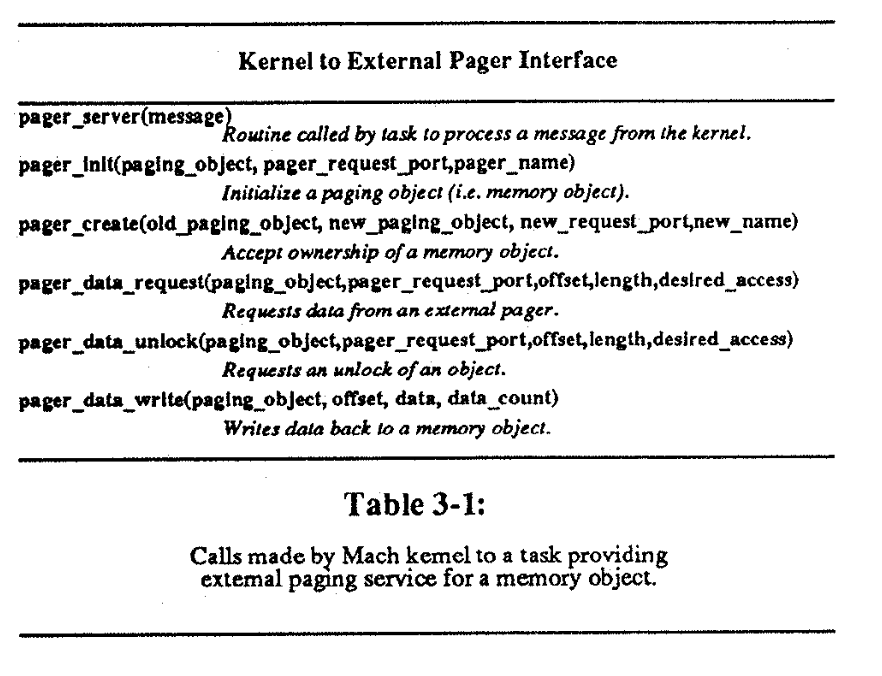
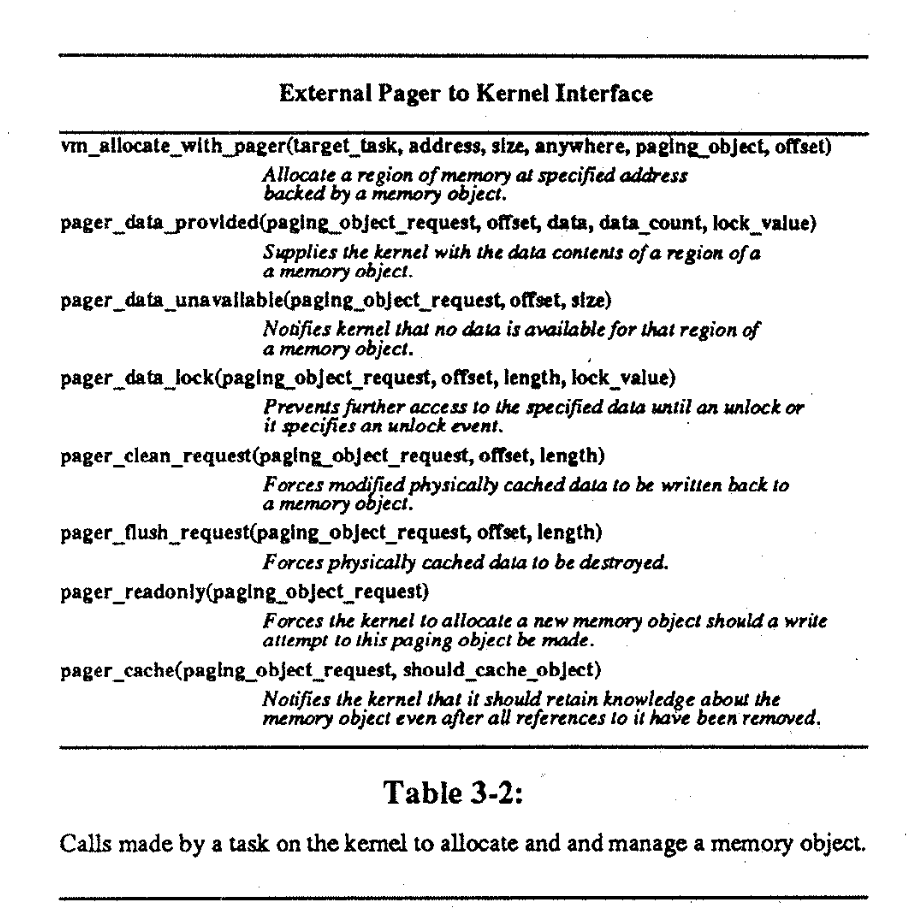
pager - task that handles page faults and page-out requests outside of kernel
- each memory object has an associated pager
- access to a pager is represented by a port (paging-object port)
- paging_name - memory object id
Sharing Memory: Sharing Maps and Shadow Objects
When copy-on-write copy is performed, two address maps which contain the copies, point to the same memory object
- This is okay as long as both tasks only read the data
- If one of the tasks writes the data “copied” in this way, a new page assessable only to the writing tasks must be allocated with the new modifications
Mach creates memory objects for holding modified pages which originally belonged to another object called Shadow Objects
- A shadow object is created as a result of a copy-on-write fault (writing by a task)
- it relies on original object that it “shadows” for all unmodified data and only creates a page for the region it modified
- A shadow object itself can be shadowed
sharing maps - identical to an address maps, but points to shared memory objects
Managing the Object Tree
Shadowing can create long chains of shadow objects. Mach automatically garbage collects shadow objects when it recognizes that an intermediate shadow is no longer needed.
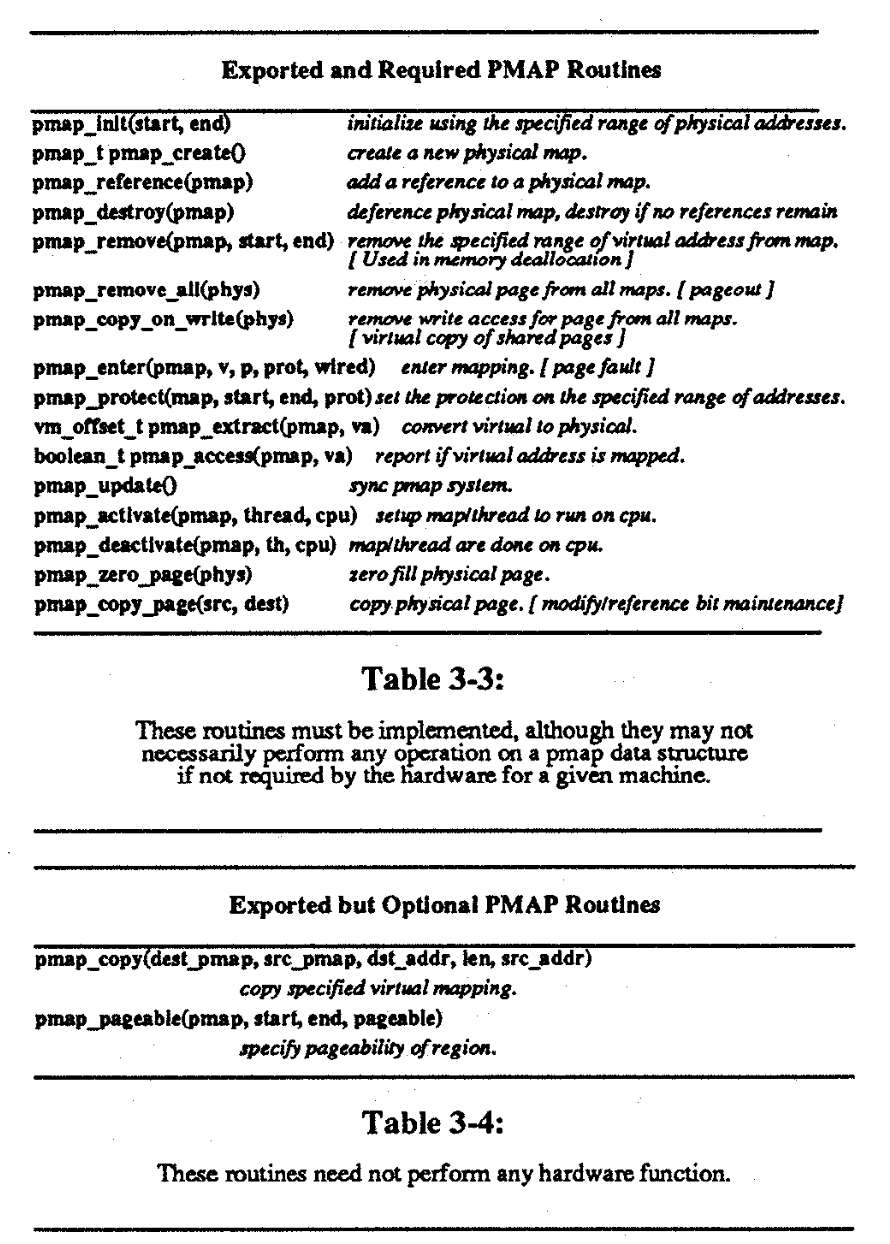
Machine-Independent/Machine-Dependent Interface
Machine Dependent:
- Physical addr maps (pmaps)
Assessing Various Memory Management Architectures
- Mach needs no in-memory hardware-defined data structure to manage virtual memory
Multiprocessor issues:
- lack of consistency when changing virtual mappings
- TLB is not kept consistent, no cache consistency