source: https://www.usenix.org/conference/osdi18/presentation/shan
Abstract
Current: Software layers for distributed applications
- Distributed systems on monolithic servers/OS
- Customize servers for different functionalities
overhead of layering constrained when customizing

Research:
- To improve resource utilization, elasticity, heterogeneity, and failure handling in data centers, the paper proposes that datacenters should break monolithic servers into disaggregated, network-attached hardware components.
- Propose a new OS model called the splitkernel to manage disaggregated systems
- Splitkernel disseminates traditional OS functionalities into loosely-coupled monitors (manager for component not OS monitor) each of which runs on and manages a hardware component.
- Splitkernels also performs:
- resource allocation
- failure handling
- LegoOS uses this splitkernel
- user applications can span multiple processors, memory, and storage hardware components
- comparable to monolithic Linux servers
background
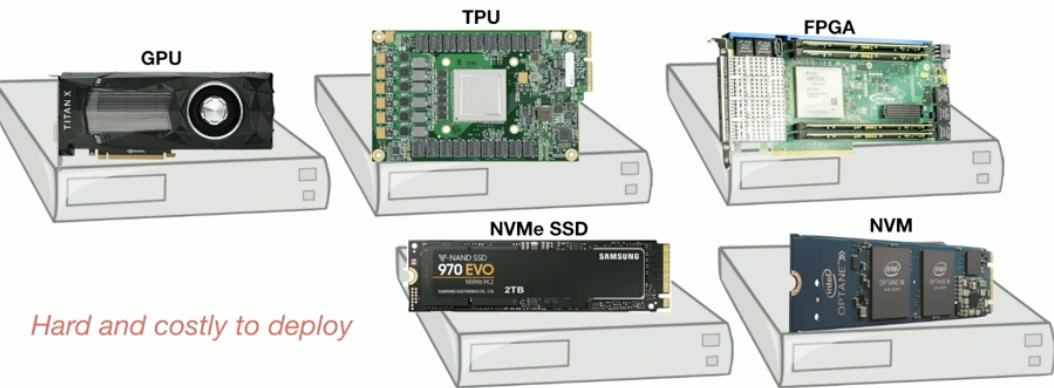
Hardware is becoming more heterogeneous
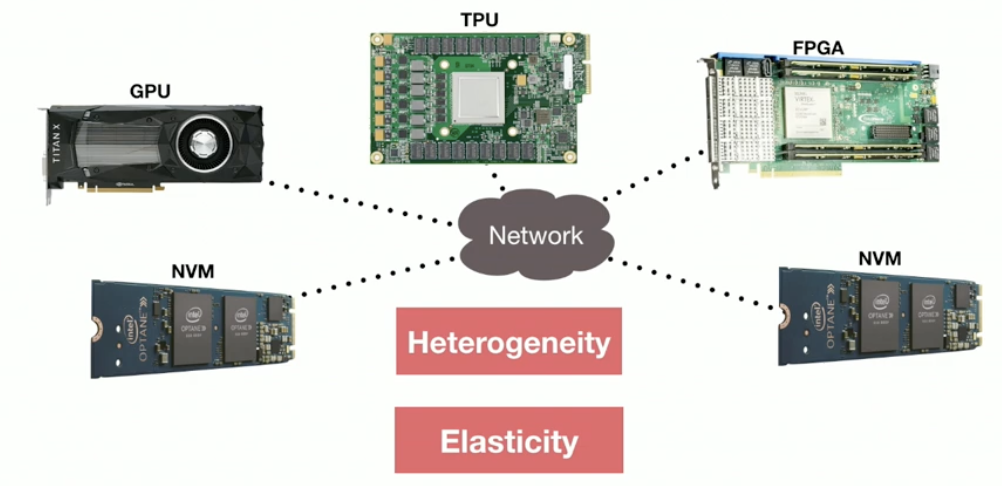
 New proposal:
Limitations of Monolithic servers
- inefficient resource utilization
- poor hw elasticity
- coarse failure domain
- bad support of heterogeneity
Problems
- bin-packing problem - trying to fit applications to physical machines. Since processes can only use process and memory in the same machine it is hard to achieve full memory and CPU resource utilization
- After packaging hardware devices in a server, it is difficult to add, remove, or change hardware components in datacenters
- modern datacenters host increasing heterogeneous hardware. However, designing new hardware that can fit into monolithic servers and deploying them in datacenters is painful and cost-ineffective
Solution
Datacenters should break monolithic servers and organize hardware devices like CPU, DRAM, and disks as independent, failure-isolated, network-attached components, each having its own controller to manage its hardware
- aka Hardware Resource Disaggregation
HW Resource Disaggregation
Other kernels:
- Monolithic - build for localized HW
- Multi-kernel - networked kernels but still monolithic HW per kernel So need to design new kernel, splitkernel, a new OS architecture for hardware resource disaggregation
- When hardware is disaggregated the OS should be also
Splitkernel
Breaks traditional operating system functionalities into loosely-coupled monitors each running at and managing a hardware component.
- All monitors in a splitkernel communicate with each other via network messaging only
Monitors in a splitkernel can be heterogeneous and can be added, removed, and restarted dynamically without affecting the rest of the system
There are only two global tasks in a splitkernel: orchestrating resource allocation across components and handling component failure
Four key concepts of Splitkernel:
- Split OS functionalities - breaks traditional OS functionalities into monitors
- Monitors are loosely-coupled and communicate with other monitors to access remote resources
- Run monitors at hardware components
- each non-processor HW component is in a disaggregated cluster to have a controller that can run a monitor.
- Message passing across non-coherent components
- runs over a general-purpose network layer like Ethernet
- neither the underlying hw or splitkernel provides cache coherence across components
- cache coherence still applies to an individual HW component like cores in CPU
- Global resource management and failure handing
- only involves global resource management occasionally for coarse-grained decision, while individual monitors make their own fine-grained decisions.
LegoOS
Distributed OS that appears to applications as a set of virtual servers (called vNodes). A vNode can run on multiple processor, memory, and storage components, and one component can host resources for multiple vNodes.
LegoOS separates OS functionalities into three types of monitors: process monitor, memory monitor, and storage monitor
Uses x86-64 architecture
Targets three types of hardware components:
- processor - called pComponent
- memory - called mComponent
- storage - called sComponent
Design goals:
- Clean separation of process, memory, and storage functionalities
- Monitors run at hardware components and fit device constraints
- Comparable performance to monolithic Linux servers
- Efficient resource management and memory failure handling, both in space and in performance
- Easy-to-use, backward compatible user interface
- Supports common Linux system call interfaces
Abstractions
LegoOS exposes a distributed set of virtual nodes or vNodes to users
From users’ point of view, a vNode is like a virtual machine. Each vNode has a unique ID, unique virtual IP addr, and a its own storage mount point.
- LegoOS protects and isolates the resources given to each vNode from others.
- Internally a vNode can run on multiple pComponents, multiple mComponents, and multiple sComponents
HW architecture
- Separating process and memory functionalities
- LegoOS moves all hardware memory functionalities to mComponents (eg. page tables, TLBs) and only leaves caches at the pComponent side
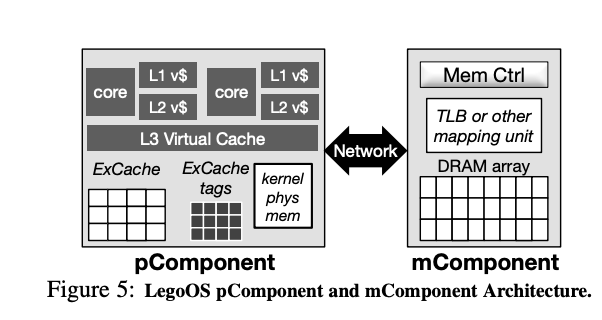
- LegoOS moves all hardware memory functionalities to mComponents (eg. page tables, TLBs) and only leaves caches at the pComponent side
- Processor virtual caches
- pComponents will only see virtual addresses and have to use virtual memory addresses to access its caches
- pComponent caches as virtual caches
- 2 problems:
- synonyms - physical address maps to multiple vaddrs
- LegoOS does not allow writable inter-process memory sharing
- homonyms - 2 addr spaces use the same vaddr for different data
- synonyms - physical address maps to multiple vaddrs
- 2 problems:
- Separating memory for performance and for capacity
- ExCache - another layer in memory hierarchy between Last-Level Cache (LLC) (in processor)
- used to serve hot memory access fasts, while mComponents can focus on providing capacity
- ExCache - another layer in memory hierarchy between Last-Level Cache (LLC) (in processor)
Process Management
- LegoOS process monitor runs in the kernel space of pComponent and manages pComponent’s CPU cores and ExCache
Process Management and Scheduling
- At every pComponent, LegoOS uses a simple local thread scheduling models that targets datacenter applications
ExCache Management When an ExCache miss happens, process monitor fetches corresponding line from mComponent and inserts it to ExCache
- supports 2 eviction policies:
- FIFO
- LRU
Memory Management
memory monitor manges both the virtual and physcial memory addr spaces:
- allocation
- deallocation
- memory addr mapings
- reads
- writes
Memory space management
- Virtual memory space management
- two level approach:
- home mComponent of a process makes coarse-grained, high-level virtual memory allocation decisions
- other mComponents perform finegrained virtual memory allocations
- At higher level split each virtual memory address space into coarse-grained, fixed-sized virtual regions or vRegions (eg. 1 GB)
- each vRegion that contains allocated virtual memory addrs is owned by an mComponent
- lower level stores user process virtual memory area (vma) information, such as virtual addr ranges and permissions
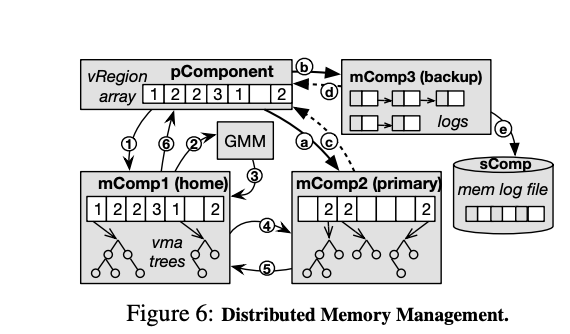
- two level approach:
- Physical Memory Space management
Global Resource Management
Uses two-level resource management mechanism
- perform coarse-grained global resource allocation and load balancing
LegoOS allocates hard-ware resources only on demand, when applications actually create threads or access physical memory
Reliability and Failure Handling
LegoOS maintains a small append-only log at the secondary mComponent and also replicates a vma (virtual memory area) tree there