Background
Classic seminal paper on RPC with goal to make remote communication accessible to as many programmers as possible.
Note:
- Exporter - server that implements the interface
- Importer - client that calls the interface
Goals
- Remote procedure calls - useful paradigm for providing communication across a network between programs written in a high-level language
- Present a package that provides an RPC implementation
- RPC mechanism
- Binding of RPC clients
- Transport level communication protocol
Introduction
Prior RPCs knowledge:
- Procedure calls - Transfer of control and data of a program running on a single computer
- Now RPC is procedure calls over a network.
- When an RPC is invoked:
- The calling environment is suspended
- Parameters are passed across the network to the environment where the procedure is to execute
- The desire procedure is executed there
- When the procedure finishes and produces its results, the results are passed back to the calling environment
- The calling environment resumes Why RPCs:
- Clean and simple semantics - easier to build distributed computations
- Efficiency - procedure calls seem simple enough
- Generality - in single-machine computations, procedures are often the most important mechanism for communication between parts of the algorithm Their RPC package:
- Built for use within Cedar programming environment for Xerox
- for single-user workstations
- Computers - Dorados - 24bit addr and 80 megabyte disk
- Comms - 3 megabit / sec ethernet
- Mesa programming language 💀
Goals
- Primary - make distributed computation easy
- make it as easy as local procedure calls
- semantics of RPCs should be as close to procedure calls as possible
- Secondary:
- RPC highly efficient
- Secure communication with RPC
Design Decisions
- Didn’t remote fork
- Didn’t emulate shared address space
- network layer didn’t support that at the time
- semantics of RPCs should be as close to procedure calls as possible
- Chose to have no time-out mechanism (prevent complexity lol)
Structure
Uses stubs and specifically 5 pieces of the program are involved:
-
user - caller
-
user-stub - placing specification of the target procedure and arguments into packets
-
RPC communications package (RPC runtime) - trasmit these reliably to the callee machine
-
server-stub - unpacks packets and makes a local call
-
server - callee Once server completes returns to the user in reverse
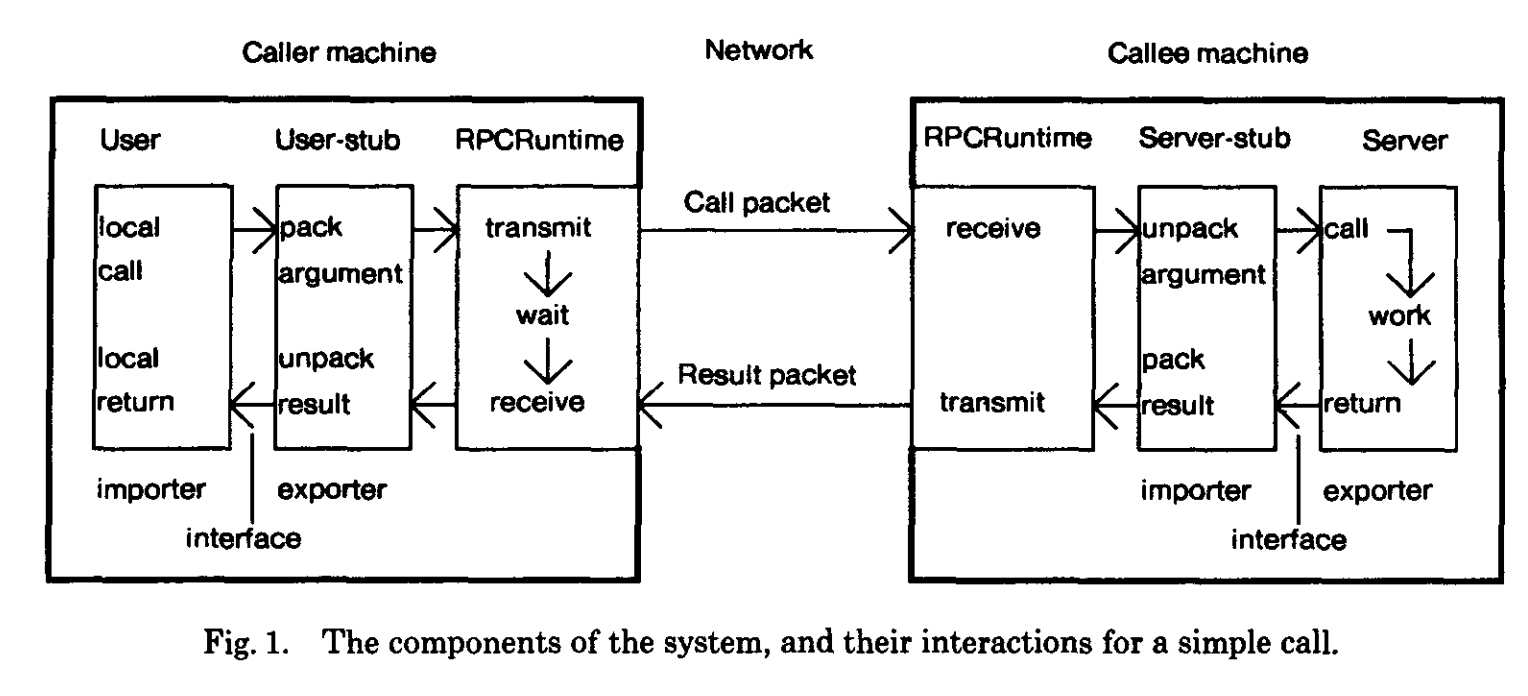
-
RPCRuntime is a standard part of the Cedar system.
-
The user-stub and server-stub are automatically generated by a program called Lupine
- Parallels to
protocand protobuf stubs - Programmer only has to design the interface, Lupine is responsible for generating the code for packing and unpacking arguments and results
- RPCRuntime is responsible for packet-level communications
- Parallels to
Binding
Two aspects to consider:
- How does client of the binding mechanism specify what he wants to be bound to?
- Question of naming
- How does a caller determine the machine address of the callee and specify to the callee the procedure to be invoked
- Question of location
Naming
- “Bind” interfaces together from caller to callee
- Interface has two parts:
- type - specify which interface the caller expects the callee to implement
- instance - specify which particular implementor of an abstract interface is desired
Locating an Appropriate Exporter
- Uses Grapevine distributed database for RPC binding (old ah mail db)
- highly reliable and data is replicated → look up missing is low
- Grapevine’s db consists of set of entries, keyed by string (Grapevine RName), and has two varieties of entries: individuals and groups
- For every individual there is:
- A connect-site or the network address
- For each group there is:
- A member-list - list of RNames
- RPC Package maintains two entries in the Grapevine data based for each interface name
- One for each type
- One for each instance
- Both type and instance are Grapevine RNames
- For every individual there is:
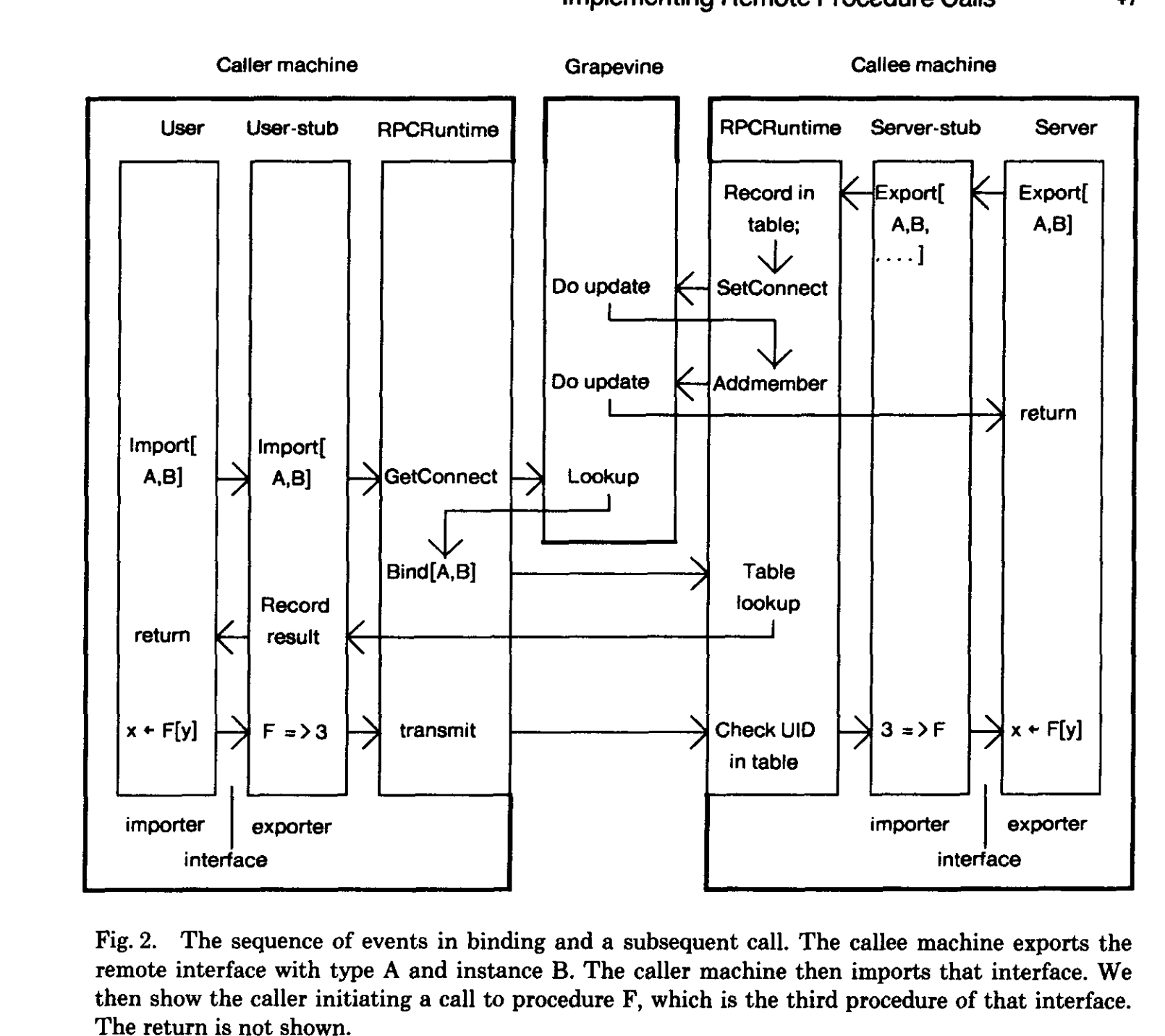
Server exports interface:
- Update Grapevine individual for instance
- Check if instance is of type’s group
- Server stores local binding metadata:
- interface type and instance
- dispatcher fn pointer
- unique 32-bit id
Client imports interface:
- Ask Grapevine for instance’s connect-site
- Contact machine and ask for binding info
- Client stub stores the binding
- Server network addr
- dispatcher table index
- unique export id
Note: They use a unique identifier scheme which means that the bindings are implicitly broken if the exporter crashes and restarts (since the currency of the identifier is checked on each call)
- correct semantics because user won’t be notified of a crash happening between calls
- allows calls to be made only on procedures that have been explicitly exported through the RPC mechanism
Packet-Level Transport Protocol
Requirements
- Minimize elapsed real-time between initiating a call and getting results
Simple Calls
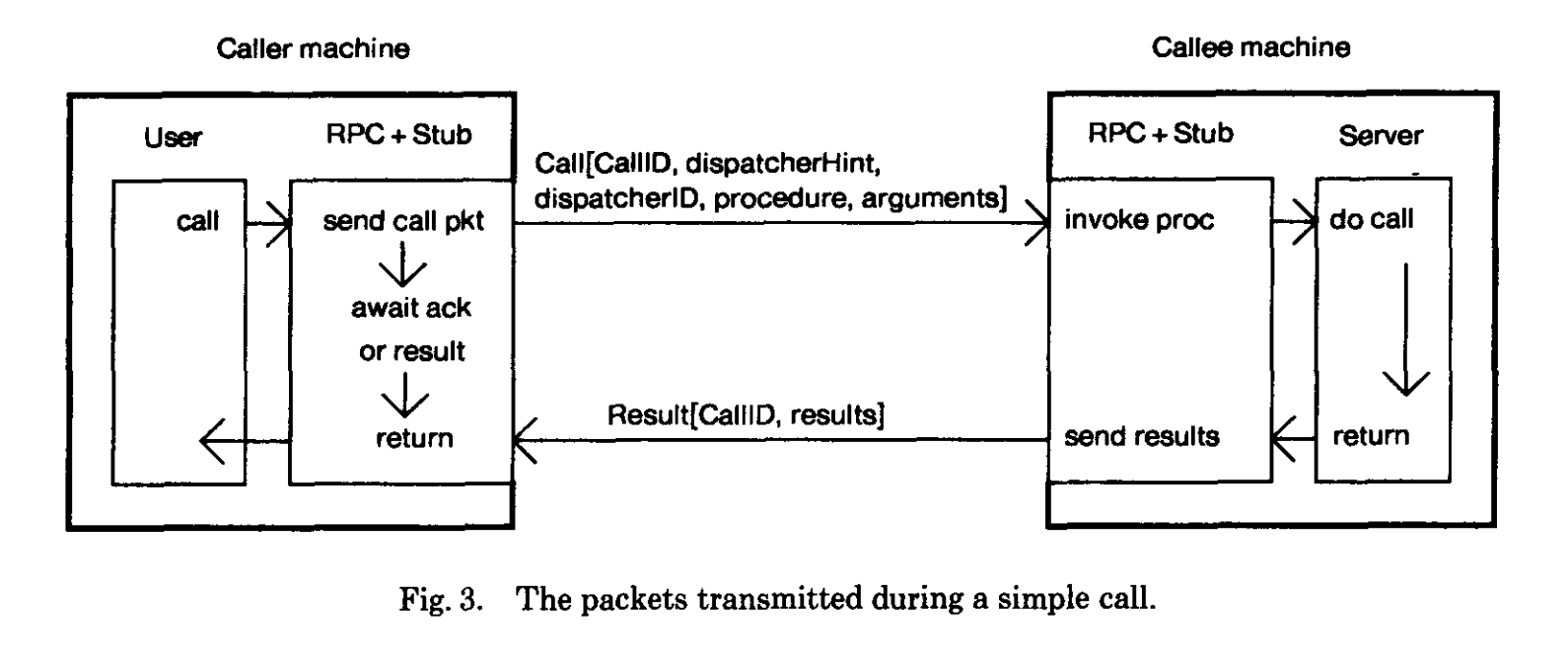
To make a call:
- Caller sends a call packet contains:
- a call id
- data specifying the desired procedure
- args
- Callee machine receives this packet and appropriate procedure is invoked
- When procedure returns, the callee sends back a result packet containing:
- call id
- results
Complicated calls
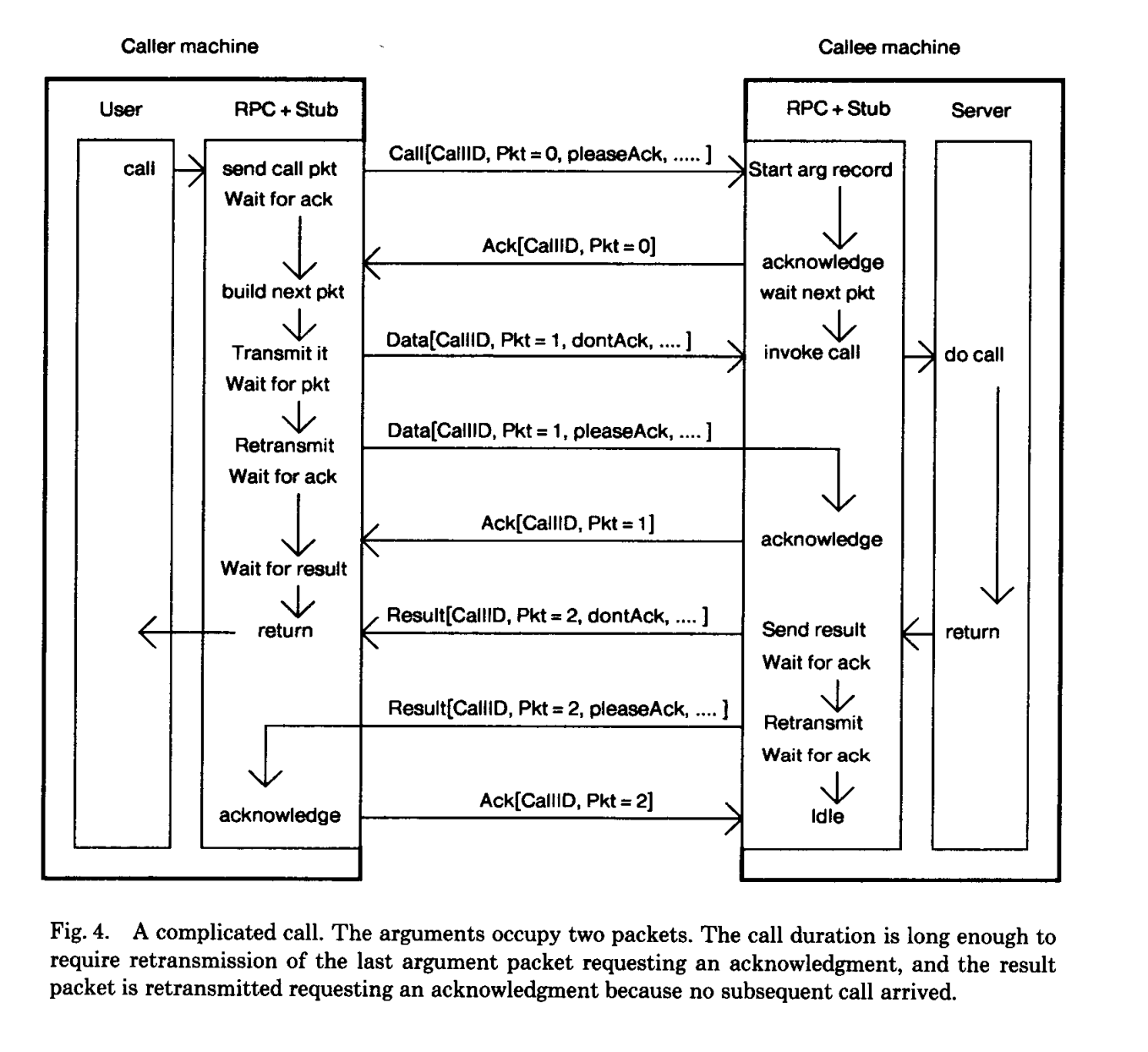
The transmitter of a packet is responsible for retransmitting it until it’s acknowledged
- While waiting, the caller periodically sends a probe packet to the callee which the callee is supposed to acknowledge. Health check with graduate increase between iterations If arguments or results are too large to fit in a single packet, they are sent in multiple packets with each but the last requesting explicit acknowledgment