Dynamic Scheduling
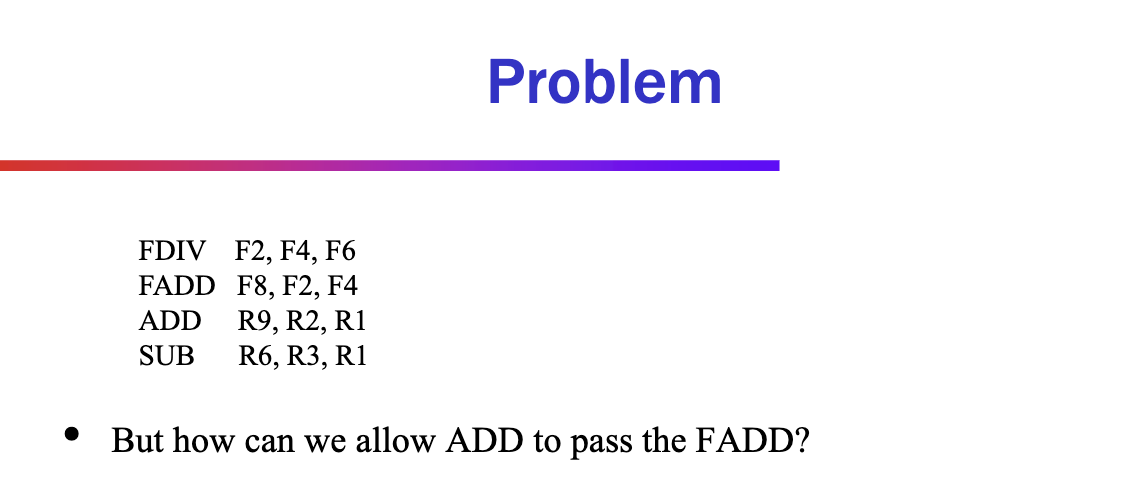
- If ID stage remains in-order, then need a way for instructions to leave ID whether or not operands ready
- This requires storage for instructions waiting for operands
- We also need a way to signal when missing operands are ready
- And we need a way to put things back in order at the end of pipeline (exceptions, branch recovery, etc)
Somehow create some storage between ID and EX stages
History
First machine CDC 6600 scoreboard
- Instruction storage added to each functional execution unit
- Instructions issue to FU when no structural hazards, begin execution when dependences satisfied. Thus, instructions issued to different FUs can execute out of order.
- “scoreboard” tracks RAW, WAR, WAW hazards, tells each instruction when to proceed.
- What the scoreboard tracks:
- Which functional units are busy
- Which registers are waiting for a value
- Which instructions are ready to issue or execute
- How it works:
- Each cycle, the scoreboard decides:
- Issue stage: Can the instruction’s operands be read safely?
- Read stage: Are operands ready?
- Execute stage: Can the functional unit start?
- Write-back stage: Can we safely write the result?
- Each cycle, the scoreboard decides:
- What the scoreboard tracks:
- No forwarding
- No register renaming Tomasulo (IBM 360/91) or reservation stations instruction Queue (MIPS R10000, Alpha 21261)
Tomasulo Algorithm
- Goal: High performance without special compilers
- Differences between IBM 360 and CDC 6600 ISA
- IBM has only 2 register specifiers/instr vs 3 in CDC 6600
- IBM has 4 FP registers vs 8 in CDC 6600
- implications?
- false dependencies all over the place
- Features:
- Put instructions in reservation stations - control and inst/operand buffers
- Register names in instructions replaced by pointers to reservation station buffer
- Tomasulo ⇒ reservations stations as operand storage
- Reservation stations replace registers names
- HW renaming of registers to avoid WAR, WAW hazards
- Tomasulo ⇒ each register read as soon as available. When possible, they are read at dispatch. If not, grabbed off the… TODO
- Common Data Bus broadcasts results to all FUs
- RS’s (FU’s), register file, etc responsible for collecting own data off CDB
- Load and Store queues treated as FUs as well
Reservation Station Components
- Stores instruction/operand buffers associated with function units
- Instruction schedule themselves
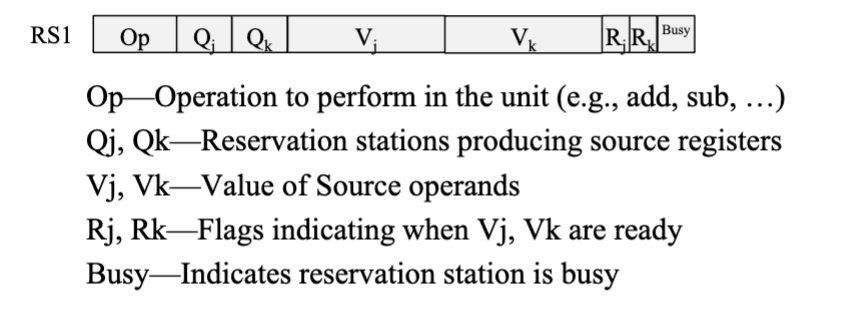
- Need another table - Register result status
- indicates which functional unit will write each register, if one exists.
- blank when there are no pending instructions that will write that registers
- used so the reg file knows which results to read and so that decoded instructions know where to find their operands
- indicates which functional unit will write each register, if one exists.
Three Stages of Tomasulo Algo
- Dispatch (issue in book) - get instruction from FP instr queue
- If reservation station free, the IQ dispatches instr & sends operands (renames registers)
- Execution - operate on operands (EX)
- When both operands ready and functional unit free then execute (“issue to the execution unit”)
- if not ready, watch CDB for result
- Write result - finish execution (WB)
- Write on Common Data Bus to all waiting units;
- Mark reservation station available
Tomasulo Summary
- prevents register file as a bottleneck
- avoids WAR, WAW hazards of scoreboard
- register renaming as a side effect (logical register names replaced by reservation station pointers)
- dynamic scheduling of instructions
- limited to basic blocks
Speculative Tomasulo Algorithm
HW support for more ILP
- Speculation - allow an instruction to issue that is dependent on branch, without any consequences (including exceptions)
- if branch is predicted incorrectly (“have HW undo”)
- typically combined with dynamic scheduling
- Tomasulo: allow speculative bypassing of results
- when instruction no longer is speculative, write results (instruction commit or instruction retire)
- 100% sure that you don’t have to HW undo the instruction
- execute out-of-order but commit in order
- requires some kind of intermediate storage that is ordered
- when instruction no longer is speculative, write results (instruction commit or instruction retire)
HW speculative Execution
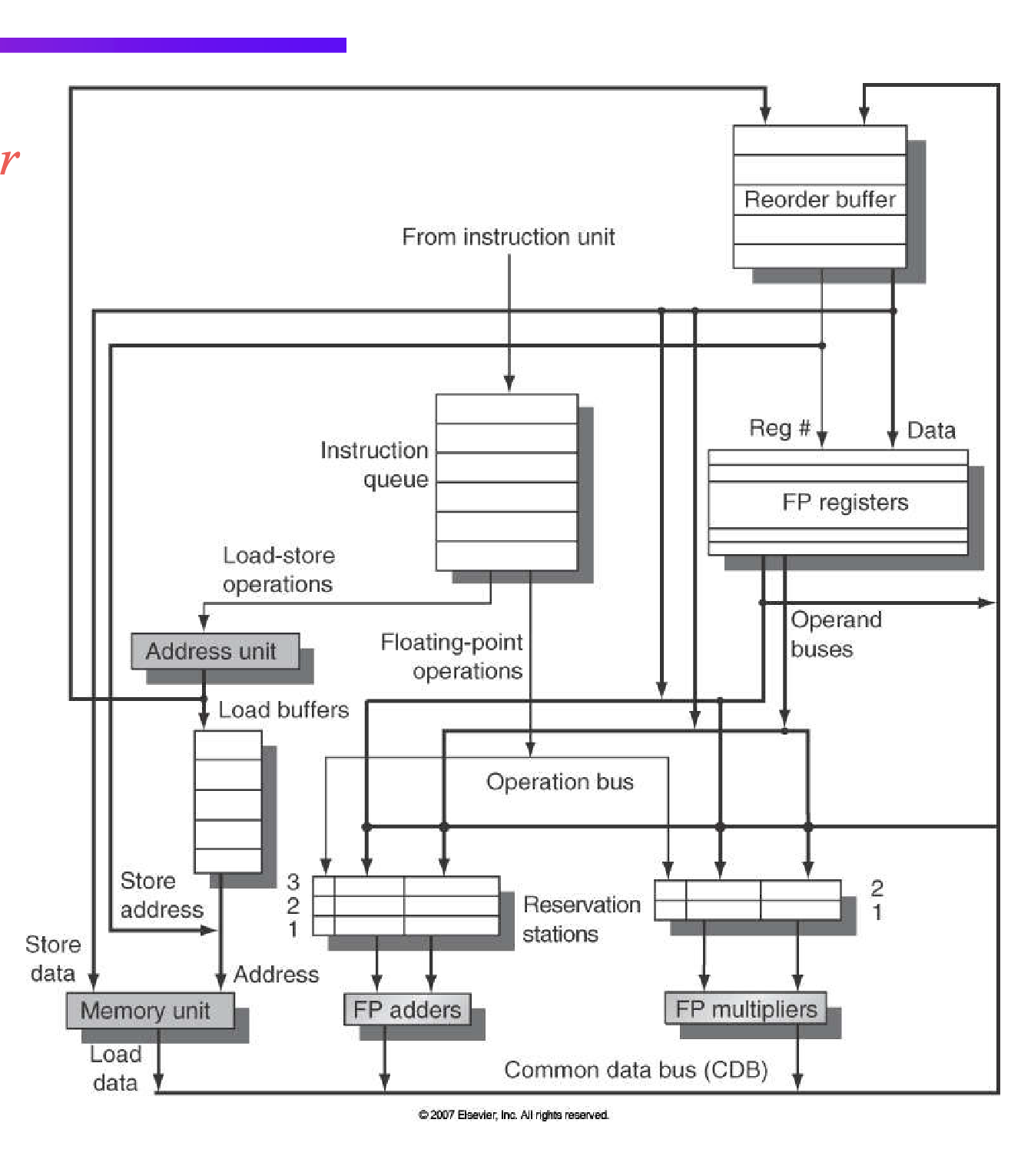 Need HW buffer for results of uncommitted instructions: reorder buffer
- Reorder buffer can be operand source
- Once operand commits, result is found in register
- 3 fields: inst. type, destination, value
- Use reorder buffer index instead of reservation station as “name” of result
- As a result, it’s easy to undo speculated instructions on mispredicted branches or on exceptions
4 steps of Speculative Tomasulo Algorithm
(ADDED commit)
- Dispatch (issue in book) - get instruction from FP instr queue
- If reservation station free, the IQ dispatches instr & sends operands (renames registers)
- Execution - operate on operands (EX)
- When both operands ready and functional unit free then execute (“issue to the execution unit”)
- if not ready, watch CDB for result
- Write result - finish execution (WB)
- Write on Common Data Bus to all waiting units;
- Mark reservation station available
- Commit - update register with reorder result
- When instruction at head of reorder buffer & result present, update register with result (or store to memory) and remove instruction from reorder buffer.
Flushing
- Assuming some checkpointing of the register result status table after branch mispredict
- that can be in the re-order buffer
Summary of Speculative Execution
- the re-order buffer and in-order commit allow us to flush the speculative instructions from the machine when a misprediction is discovered
- ROB is another possible source of operands
- ROB can provide precise exceptions in an out-of-order machine
- ROB allows us to ignore exceptions on speculative code